
Tools for caching for site
Caching tools are mechanisms that store temporary copies of website data or pages to avoid regenerating them with each user request.
On the server, caching allows you to:
- reduce CPU and database load;
- speed up page loading;
- handle a higher number of concurrent visitors;
- improve website stability during peak traffic.
Instead of executing PHP code and database queries each time, the server returns a saved result, significantly saving resources.
Below, we'll look at the caching tools that are already installed on eVPS and dedicated servers with the Smart Panel.
Management is available from the Owner and Administrator accounts.
What are Memcached and Redis?
Memcached and Redis are high-performance in-memory data caching systems that help quickly store and retrieve data, reducing database load and increasing the performance of websites and applications. The choice depends on your goals: Memcached is often sufficient for simple caching, while Redis is suitable for more complex data structures. Consider the specifics of your infrastructure and project needs.
Memcached is a lightweight and fast cache server.
- Stores data as key-value pairs.
- Primary use: caching objects and pages, and reducing database queries.
- Does not have complex data structures or additional features.
Redis is more powerful and flexible.
- Supports various data types: strings, lists, sets, hashes, and binary data.
- Can be used as a cache, message broker, or high-speed database.
- Provides replication, persistence, and transactions.
How to work with Memcached and Redis?
Activation
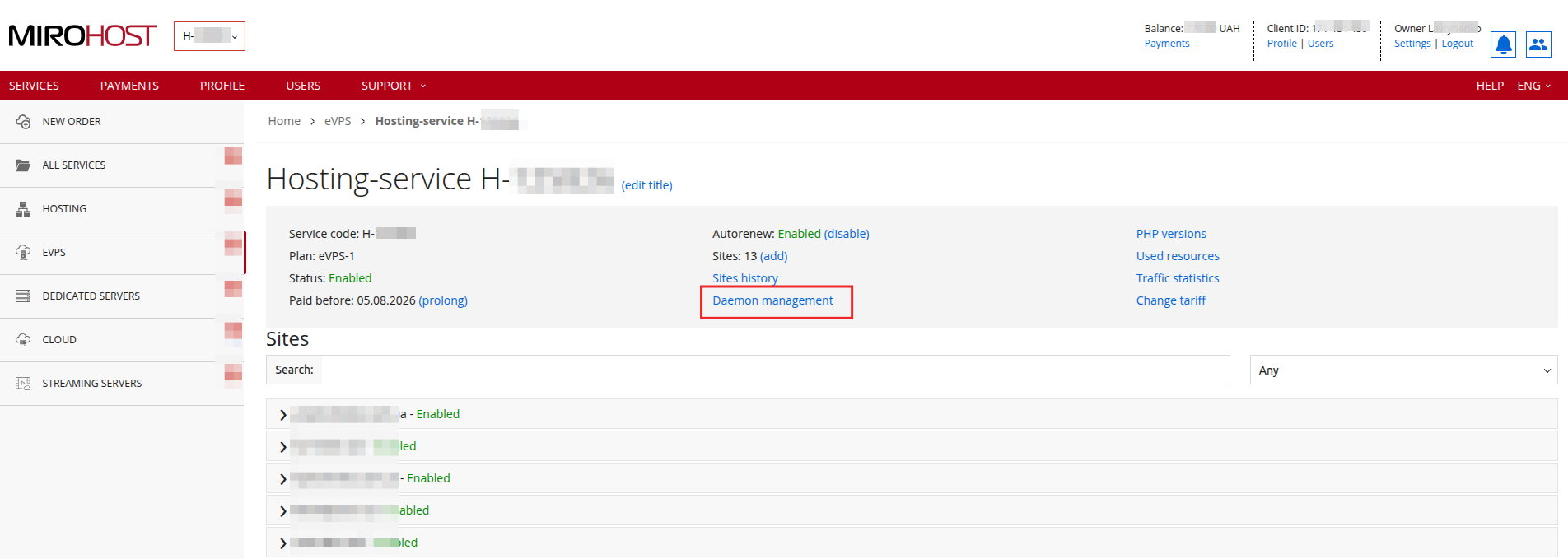
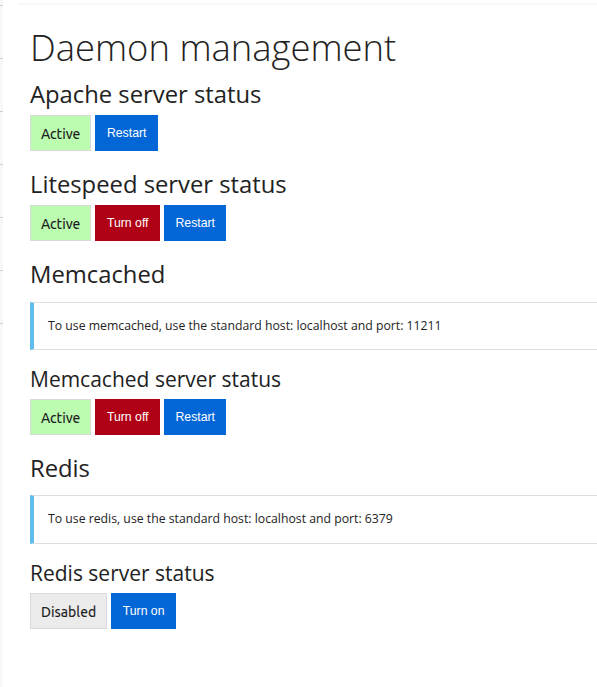
You can activate one of the applications in the hosting control panel, in the "Service Management" section on the main page of the hosting package.
Usage
- Web applications or CMSs, such as WordPress, can use these systems to cache data.
- Install the appropriate plugin or library and configure the connection.
- Store objects or pages in the cache for quick retrieval.
PHP example:
// Redis
$redis = new Redis();
$redis->connect('127.0.0.1', 6379);
$redis->set('ключ', 'значення');
echo $redis->get('ключ');
// Memcached
$memcache = new Memcached();
$memcache->addServer('127.0.0.1', 11211);
$memcache->set('ключ', 'значення');
echo $memcache->get('ключ');
What are the alternatives?
- Varnish Cache — HTTP proxy, caches web server responses.
- NGINX Cache — configure caching at the NGINX level.
- APCu — PHP in-memory cache.
- CDN (Content Delivery Network) — Cloudflare, BunnyCDN, Akamai, which speed up content delivery.
- Cache handling via WordPress plugins — W3 Total Cache, WP Super Cache, LiteSpeed Cache.
- Database Cache — uses persistent caches to reduce load.
Advantages and Disadvantages of Website Caching Tools
| Advantages | Disadvantages |
|---|---|
| Increases website speed | Not suitable for long-term data storage |
| Reduces database load | Requires additional configuration |
| Ease of connecting to a site | Not all types of data are suitable for caching |